THE BIG PICTURE | MARKETING & SALES
Immersive marketing: another layer to the customer journey.
Your marketing creates interest. What can customers explore next? An immersive experience adds somewhere to investigate the details, involve other people and continue the conversation with your team.
 Dean ScholeyFounder, VirtualPro | 29 November 2026 · 6 min read
Build on the marketing you already have
A campaign, a photograph or a video can introduce an offer and give someone a reason to pay attention. A brochure, an exhibition or a showroom visit can start a conversation. Customers then need ways to explore the questions that follow.
I see immersive marketing as an additional layer within that journey. It gives people an interactive way to explore a product, place or environment alongside the branding, imagery and messages a business already uses.
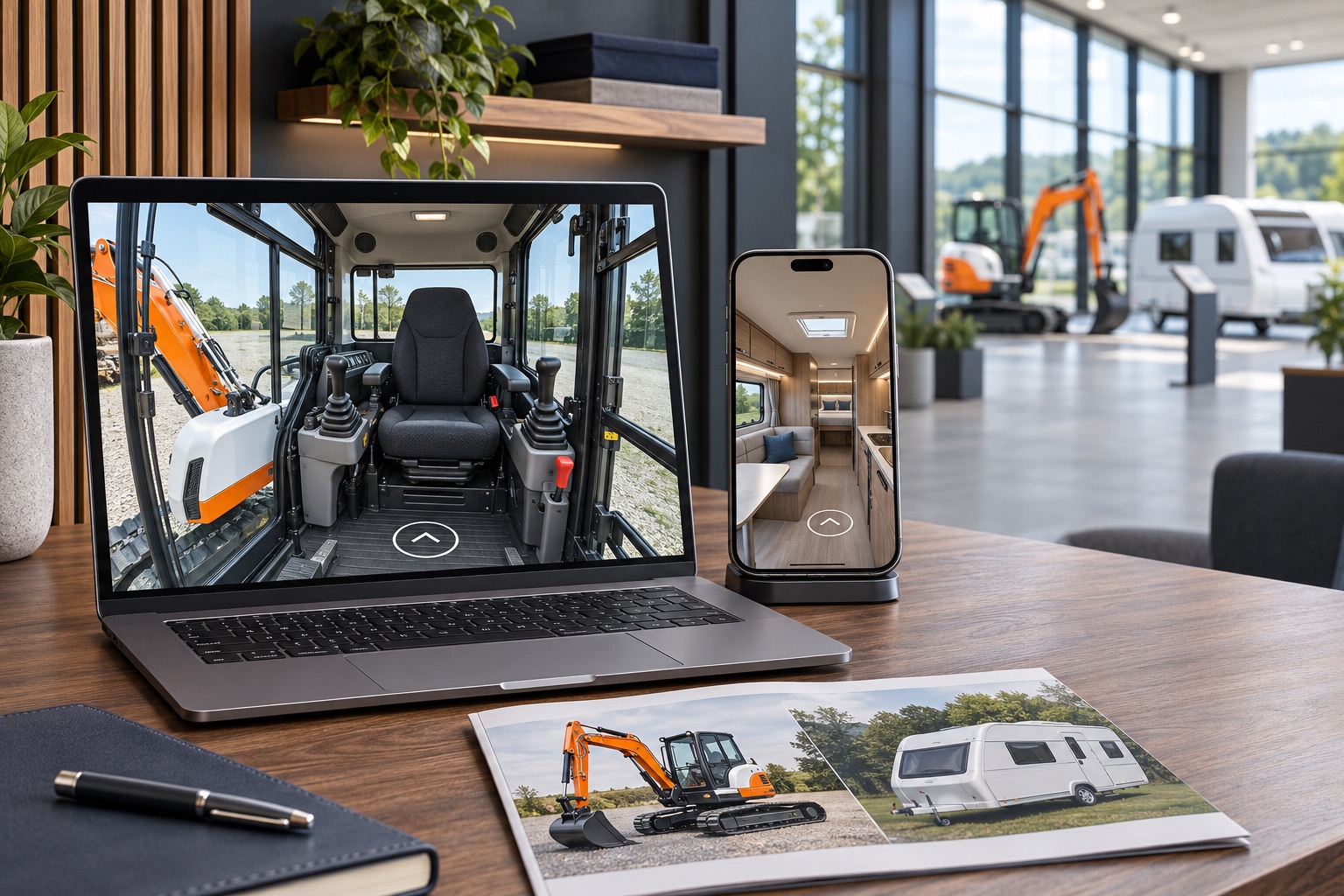
That might be a 360° product spin, a virtual walkthrough or a showcase with feature information built into it. Each offers a different kind of access. The useful starting point is the customer’s question: what do they need to see or understand before the next conversation?
Support the moments between conversations
Customers may encounter your business several times before making an enquiry or purchase. They might see a campaign, visit a dealer, discuss the options with a colleague and return to your website. The information they need changes along the way.
An experience they can revisit gives your marketing and sales team a shared point of reference. Someone can check a detail after a meeting, show another decision maker what interested them or arrive at the next conversation with more specific questions.
This is what keeping customers engaged can look like in practice: making useful exploration available when they need it.
Explore the offer
Investigate the product, layout or features that caught your interest.
Look together
Use a shared view to explain a feature and discuss questions.
Revisit and share
Return to the details and involve others helping with the decision.
Give sales teams something useful to work with
For a sales director, the opportunity extends beyond what appears on a website. A team can use the experience during a remote meeting, in a showroom or as part of a proposal and follow-up.
A consultant could point out storage in a boat, discuss the layout of a show home or show where a component sits on a machine. Afterwards, the customer can return to the same reference.
Our Rayglass story explores the role of a virtual showcase between showroom visits. The practical question for any business is similar: what would help your customers continue investigating after you have spoken?
What can you add to a showcase?
The experience can bring supporting material closer to the feature or space being explored. Depending on the platform and project, it can include:
- Video demonstrations
- Link to or embed a video showing a feature in operation, a process or an explanation from your team.
- Labels and information points
- Identify features and let customers open descriptions, specifications, photographs or relevant documents.
- Relevant enquiry links
- Offer a way to ask a question, request a demonstration or arrange a visit while the customer is exploring.
- A customised interface
- Use your branding, navigation and chosen content to organise the experience around your customers and the way your team sells.
- Analytics and interaction tracking
- Where supported and configured, record actions such as feature openings, video plays and enquiry-link selections to understand how the experience is being used.
These additions need a purpose. A useful label answers a question. A demonstration explains something the customer can see. A contact option makes the next step clear.
Connect exploration with an enquiry
An immersive experience can sit behind a campaign, a QR code on a brochure or a link shared by a dealer. Once someone arrives, the next step should relate to what they are considering.
For example, a person exploring a machine could open a feature explanation, watch a demonstration and request a discussion with the sales team. The role of the showcase is to connect useful information with a relevant opportunity to enquire.
Whether that produces more enquiries, better questions or a different quality of lead is something to measure. Agree what a useful outcome looks like before launching the experience.
What does research on 360° product views tell us?
Spin photography is one example of giving customers control over the view. A 2016 laboratory study involving 366 participants compared static pictures, 360° spins and virtual mirrors. Participants experienced a stronger sense of product tangibility with spins than with static pictures. The research also linked aspects of tangibility with how useful a presentation was for evaluating the product. [1]
A 2020 paper reported three experiments on rotatable product images. The first found higher purchase intention than with static images. Later experiments showed that the effect depended on how mentally occupied participants were. These were measures of intention, rather than completed sales. [2]
My reading is that interaction is most useful when it helps someone evaluate what they are looking at. These studies offer support for thoughtful product exploration; they do not establish a universal sales result. Findings about product spins also cannot automatically be applied to virtual walkthroughs or every other immersive format.
Put the experience to work across the business
For marketing managers, brand consistency and distribution matter. The experience needs to be easy to find from the channels already bringing people to the business: product pages, campaigns, proposals, exhibitions and dealer showrooms.
For general managers, the question includes how the asset will be maintained, who will use it and how it fits existing processes. Someone needs to keep the information current and help the team put it into use.
Orbitvu’s supplier-published McLeod Accessories case study illustrates a related approach: producing stills, spins and video within one content workflow, with imagery used across websites, catalogues, brochures and retailer listings. It is an example of content supporting several channels, rather than independent evidence of a sales increase. [3]
Start with one experience. Learn from its use.
Choose one product or environment and a specific point in the customer journey. Decide what questions the experience should help answer, where people will encounter it and how the sales team will use it.
Then review both behaviour and feedback. Which information points are opened? Do people follow the enquiry links? Does the team find it useful in conversations? Are customers able to find the information they expected?
Tracking needs to be configured for the chosen platform, with appropriate privacy information. A feature opening records an interaction; it does not tell you that someone is ready to buy. Combine those signals with enquiry outcomes and conversations with your team.
The aim is to understand where this additional layer helps your customers and your business, then use those findings to decide what comes next.
LET’S START WITH A CONVERSATION
Where could this fit in your marketing?
Get in touch for a no-obligation conversation. We’ll share results, findings and lessons from current and past projects, and discuss where an immersive experience could support your business.